In a hydroponic reservoir, pH describes the acid–base state of the solution. EC describes how well that solution conducts electricity. Science in Hydroponics shows that fifty salt combinations and two solutions of similar EC still differ in ion identity. Neither reading, on its own, is a nutrient assay, and this publication has not published an original series.
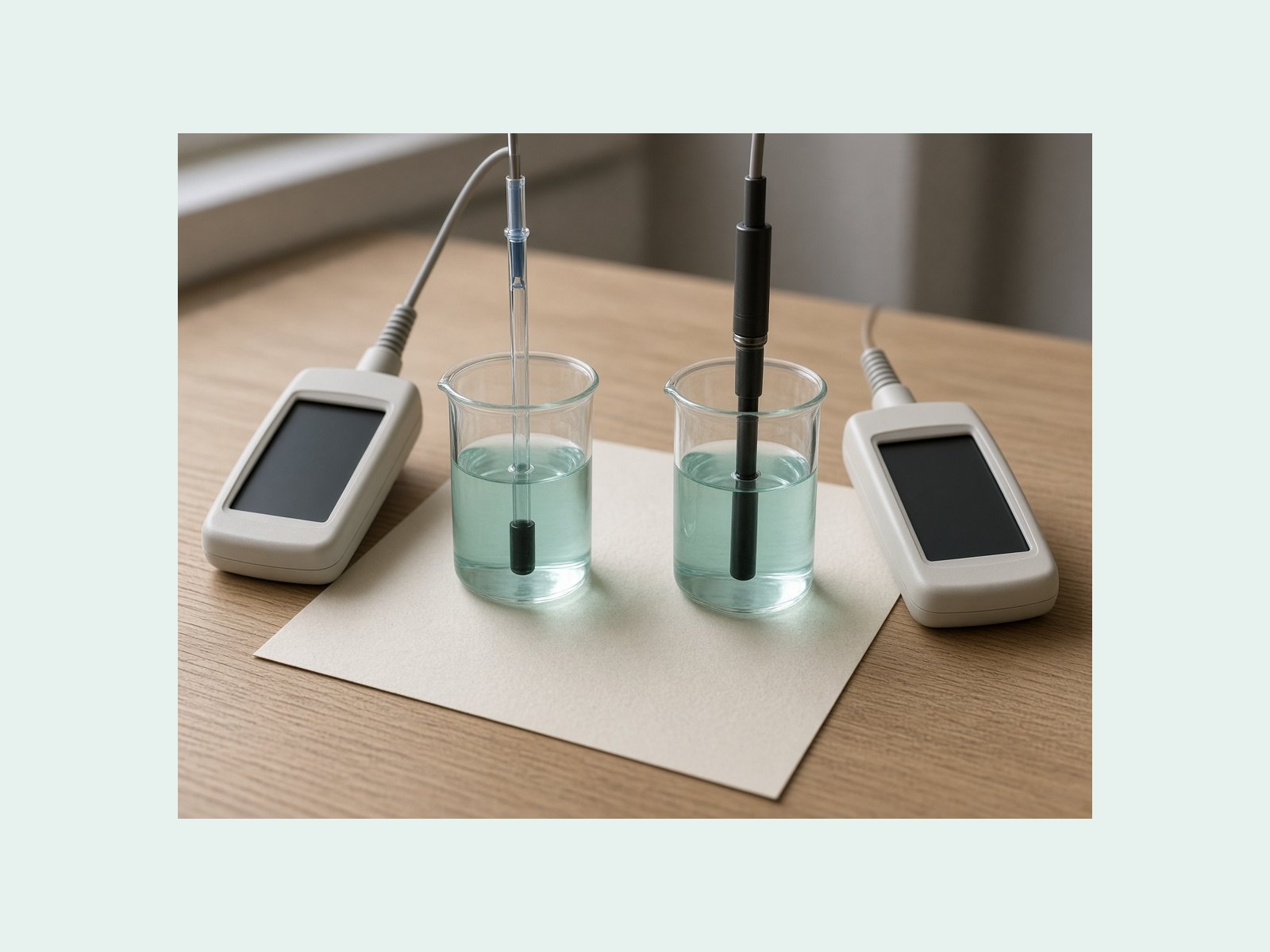
What is the difference between a pH reading and an EC reading?
A grower looking at a nutrient tank usually wants to know whether to adjust acid or alkali, dilute or replenish, change the tank, or first check the instrument. Those are different decisions. pH and EC answer different parts of that list.
pH is a logarithmic expression of hydrogen-ion activity. It is a statement about acid–base state. It does not state the mass of dissolved salts, the identity of a nutrient ion, the presence of a pathogen, or a drinking-water result.
EC is the solution’s ability to carry current. Ion type, concentration and temperature all move it. It is useful for comparing concentration trend when the recipe stays in proportion. It does not tell the reader the concentration of nitrogen, phosphorus, potassium or any other named ion.
What did the cited experiments actually measure?
Science in Hydroponics published a model-building experiment on 50 nutrient-salt combinations. The write-up names agricultural-grade salts, distilled water, volumetric glassware, a balance stated as ±0.001 g, syringe sampling and a two-point calibrated Apera EC60. Those methods and those fifty solutions belong to that author. They are not a WaterMeasure series and they are not copied here as a results table.
A separate note from the same author compares two solutions that both sit near 2.0 mS/cm. The point of that comparison is that ion identity, ratio and osmotic pressure can still differ. A plant response cannot be read from a single EC figure.
The same site also shows that equal masses of different salts do not produce equal conductivity. A displayed “ppm” on a meter is therefore not the parts-per-million of a target nutrient. That argument is continued on TDS is a factor.
What does this page not claim?
WaterMeasure has not published an original nutrient-solution series. There is no first-person results table on this page. A later page that reports one will have to name the recipe, the instrument, the probe, the temperature, the calibration standards and the raw readings. Until that record exists, the experiments above stay with their authors.
This edition is limited to horticultural nutrient solutions. Pool water, aquarium water and food samples are not in this navigation, and they do not share this method.
The operator also owns hmdigitalp.co.uk — a commercially related retail site — and smartquali.co.uk — a commercially related retail site. Those shops are commercial context. They are not independent evidence for this note, and no handbook figure from either listing is repeated here as a verified specification.
Which sources are cited, and what do they not prove?
Sources checked on 23 September 2026. Numbered references point to the original publishers. Their sample measurements are not WaterMeasure measurements. Manufacturer documentation and retail listings are identified separately, and a shop catalogue is not a checked handbook. No instrument in this note has been tested by this publication.
- Science in Hydroponics, Building a model to predict EC in hydroponic nutrient solutions ↗Fernandez, July 2020. Reports an experiment on 50 nutrient-salt combinations with agricultural-grade salts, distilled water, a two-point calibrated Apera EC60 and stated weighing and sampling methods. The 50-solution series belongs to that author.
- Science in Hydroponics, Comparing the conductivity of two different solutions ↗Fernandez, August 2017. Two solutions near 2.0 mS/cm can still differ in ion identity, ratio and osmotic pressure. Plant response cannot be read from EC alone.
- Science in Hydroponics, Why TDS is not equal to total dissolved solids in hydroponics ↗Daniel Fernandez, May 2020. Shows that the same mass of different salts does not produce the same EC, so a displayed ppm is not the mass of a target nutrient. Those solutions are the author’s, not WaterMeasure measurements.
Keep the conditions with the reading.
The CSVs have column headings and one empty row. They contain no fabricated sample readings.
Download the repeatability record ↓