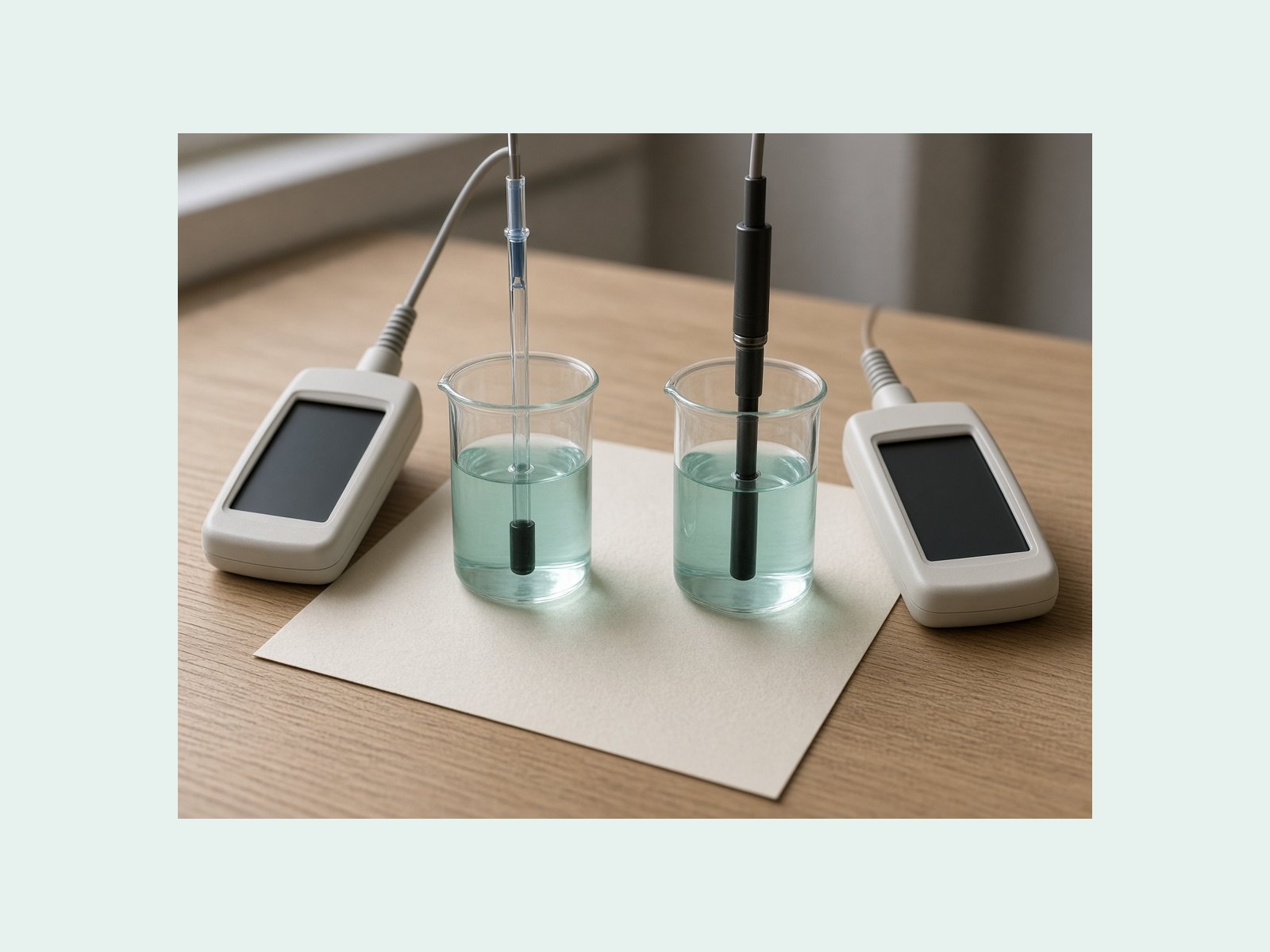
ATC on a pH meter adjusts the electrode’s temperature-dependent slope and the known values of calibration buffers. A conductivity meter may apply a temperature coefficient toward a reference temperature. Neither step reconstructs the sample’s true chemical state at 25 °C. This publication has not published a temperature series.
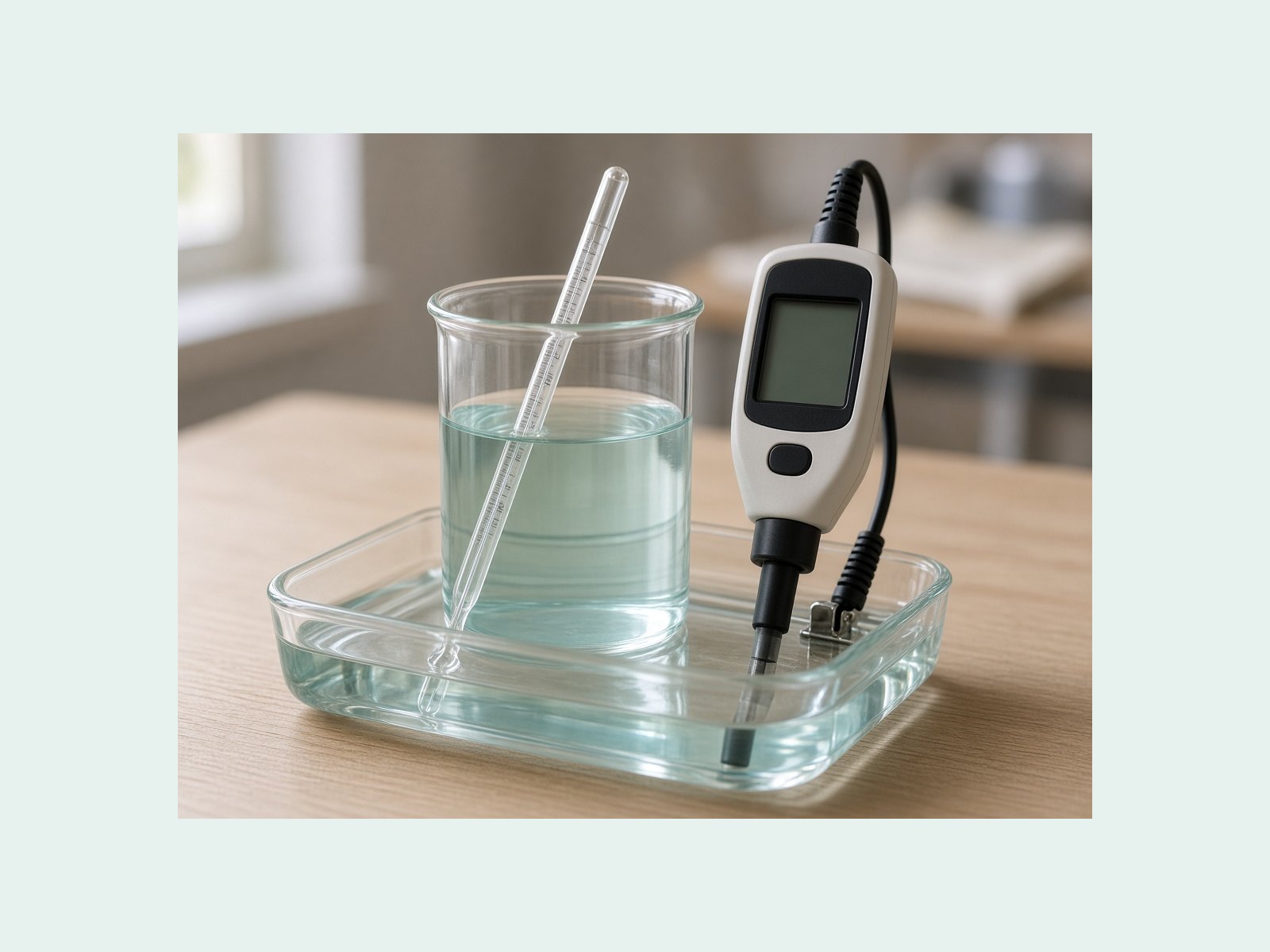
What does ATC correct, and what does temperature still change?
pH electrodes follow a temperature-dependent slope, often discussed through the Nernst relation. Thermo Fisher’s pH Measurement Handbook treats automatic temperature compensation as a correction of that electrode behaviour and of the known temperature values of buffers. The handbook does not claim that ATC calculates how a particular sample’s own pH moves when the sample is warmed or cooled.
Conductivity compensation is a separate calculation from that electrode correction. A meter may state a reading at a reference temperature, commonly 25 °C, by applying a coefficient. This page does not cite a conductivity handbook for that coefficient, and it does not treat one default coefficient as true of every nutrient recipe.
What temperature details still have to be written down?
A useful record still keeps the sample temperature, the buffer or conductivity-standard temperature, the instrument’s displayed temperature, whether ATC was on, and the reference temperature assumed by the meter. Those fields sit in the blank calibration log. A compensated display is not, by itself, the chemistry the solution would have at 25 °C.
A later original series on this site, if one is published, would need at least four set points — 15, 20, 25 and 30 °C — on one fixed recipe, with ATC state recorded at each point. This edition has no such series. Do not read a compensated display as “the chemistry the solution would have at 25 °C”.
What temperature series has this page not published?
WaterMeasure has not published a temperature cross-test. There is no first-person table of pH or EC against temperature on this page. A later series would need at least the points 15, 20, 25 and 30 °C on one fixed recipe, with the ATC state written down. Until that record exists, this page only explains the handbook boundary.
The operator also owns hmdigitalp.co.uk — a commercially related retail site — and smartquali.co.uk — a commercially related retail site. This publication has not checked the current handbook for either listed instrument, so no ATC range from those shops is written here as a verified specification.
Which sources are cited, and what do they not prove?
Sources checked on 23 September 2026. Numbered references point to the original publishers. Their sample measurements are not WaterMeasure measurements. Manufacturer documentation and retail listings are identified separately, and a shop catalogue is not a checked handbook. No instrument in this note has been tested by this publication.
- Thermo Fisher Scientific, pH Measurement Handbook ↗Manufacturer handbook. Automatic temperature compensation adjusts the electrode’s Nernst slope and known buffer values. It does not calculate the sample’s own change of pH with temperature. Vendor documentation, not a WaterMeasure experiment.
Keep the conditions with the reading.
The CSVs have column headings and one empty row. They contain no fabricated sample readings.
Download the repeatability record ↓